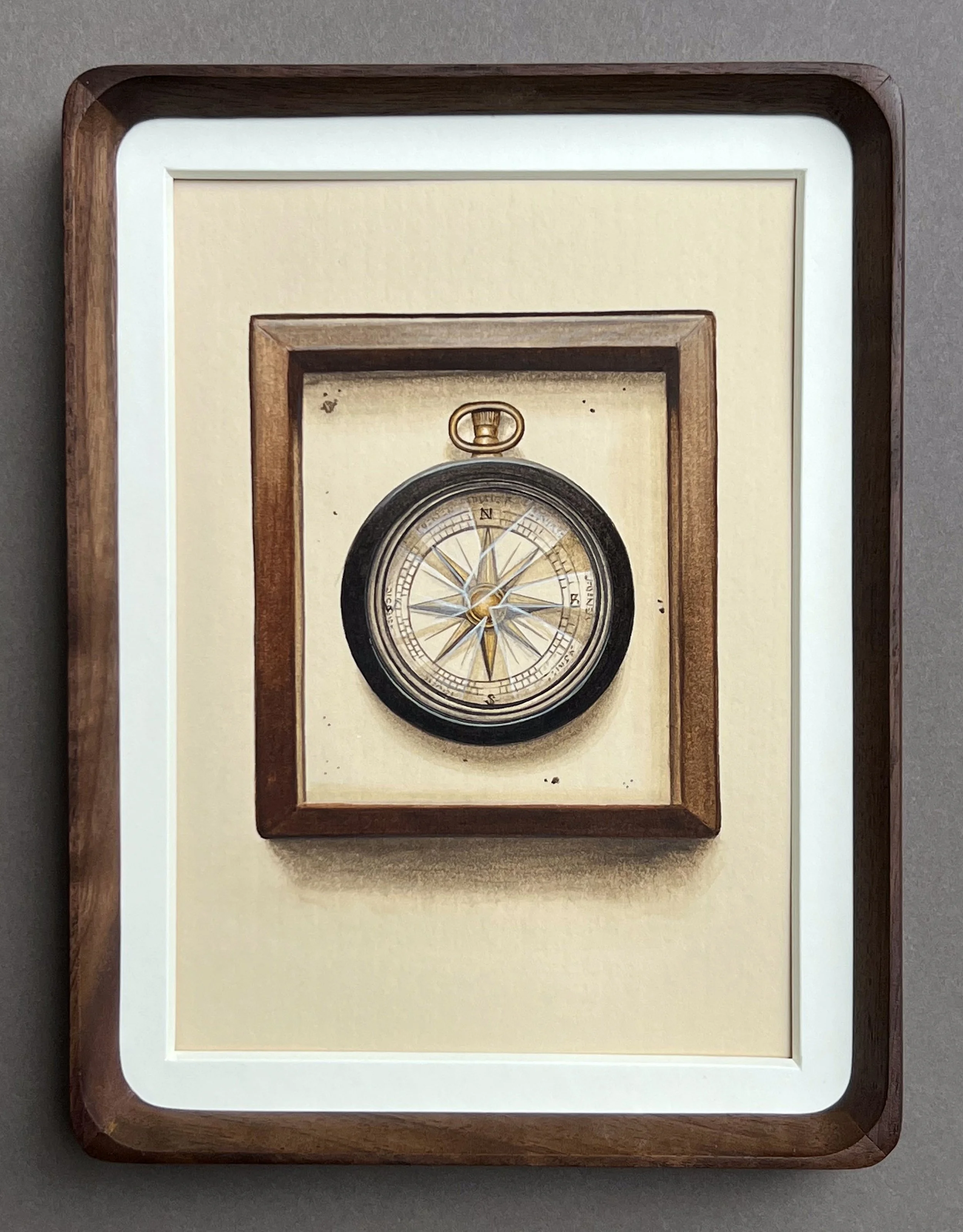
The Museum of Lost Evidence is a series of small works about how we come to know the world through attention. Drawing from the visual language of natural history, each piece appears like a tiny artifact — something found, preserved, misfiled, or momentarily rediscovered. Together, they explore how easily meaning fades when we look away, and how much becomes visible again when we slow down.
Some works examine the limits of classification: a hybrid bird presented as fact, a parasitic ant revealing hidden dependency, a beetle mislabeled through oversight. Others turn toward quiet resilience, like the interwoven community of mosses and lichens that anchors entire ecosystems. Several pieces explore what happens when representation begins to stir toward life, while others look inward at the tools and inner structures that shape perception — a broken compass, a vial of shared air, the anatomy of attention.
Rather than a museum of fixed answers, this series imagines a living archive of curiosity. The Museum of Lost Evidence invites viewers to look closely, notice what endures, and reconnect with a world that reveals itself only when we take the time to look.
The Broken Compass opens the series with a navigational instrument missing its needle and fractured across the glass—an object built to orient, now unable to fulfill its purpose. Removed from use and preserved as an artifact, the compass becomes a study in dislocation, its damaged structure echoing moments when our systems of direction falter or lose coherence.
Within The Museum of Lost Evidence, the piece reflects on how instruments of guidance—whether scientific, cultural, or personal—are shaped by the conditions in which they are used. Rather than offering a prescriptive path forward, The Broken Compass suggests that orientation may arise from attention itself: the slow work of noticing, reassessing, and finding direction within uncertainty.