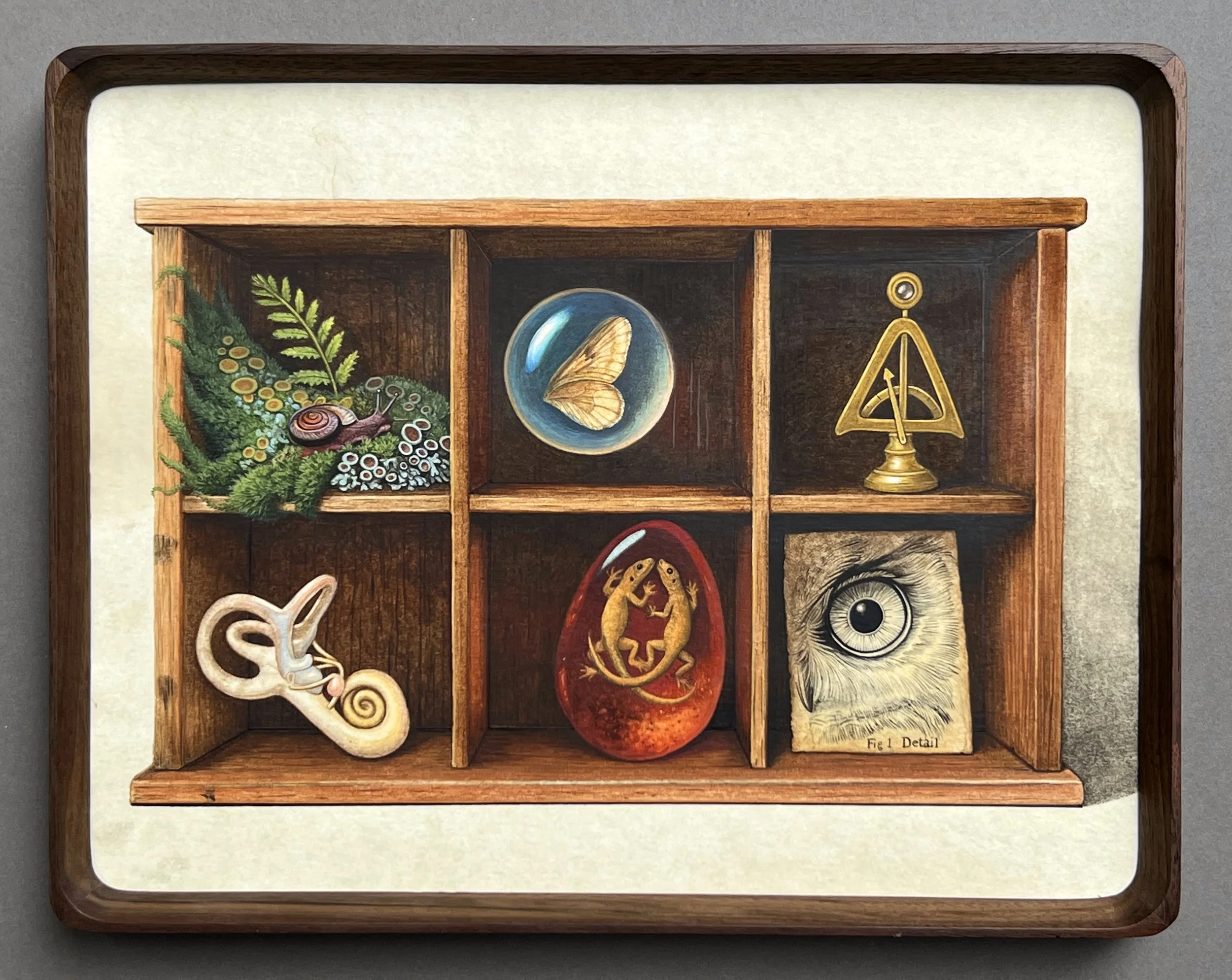
In The Museum of Lost Evidence, Bozic turns the naturalist’s cabinet inward, assembling the small instruments through which perception takes shape. Each chamber becomes a facet of sensing: moss and fern suggest the body’s slow, peripheral awareness; a hybrid metronome–sextant evokes the calibration of focus; an enlarged cochlea listens inward; an owl’s eye studies the act of seeing itself; a moth’s wing, held within a glass sphere, catches the fleeting nature of attention; and two lizards suspended in amber embody memory held in time.
Together, these elements form a quiet diagram of perception—a system where listening, seeing, remembering, and orienting intertwine. The Anatomy of Attention invites reflection on how we notice the world, and how that noticing becomes a form of understanding—a meditation on the fragile architecture through which meaning is gathered.
The full context of the series begins with The Broken Compass.